Reflexology, body and energy systems during perimenopause
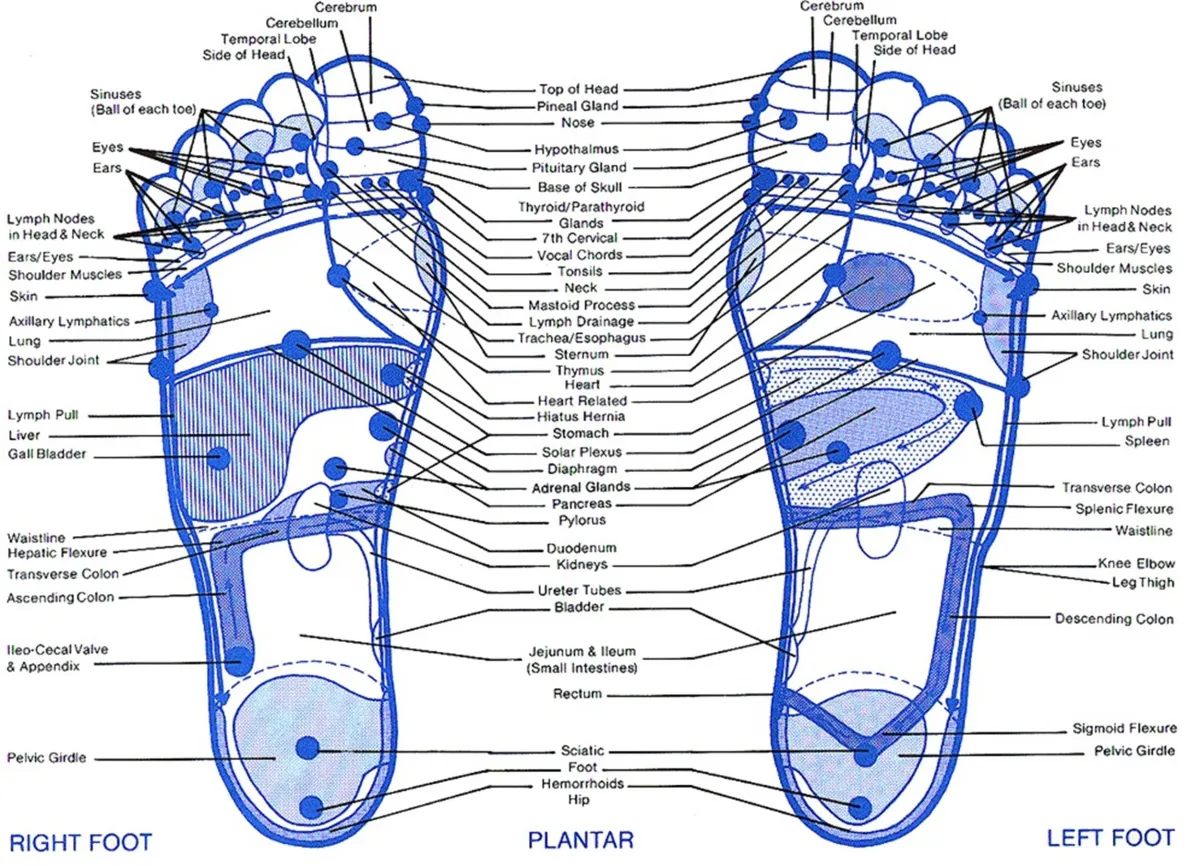
When you lie back for a reflexology session, it may seem like the practitioner is simply working on your feet; but in truth, we are working with your whole body through your feet. There are over 200,000 nerve endings in your feet, all connected to the rest of your body. In reflexology, we don’t work with each of these individually, but through specific areas known as reflex points - regions that are especially nerve-rich and correspond to organs and systems within your body.
Reflexology is therefore deeply interconnected with your inner systems, both physical and energetic. One of the most fascinating aspects of this practice is how the endocrine glands, reflex points, and chakra system align and influence one another.
This becomes especially relevant during perimenopause, a time when your body is not simply ‘losing hormones’, but reorganising how your entire endocrine system communicates. Altogether, what is changing is not just hormone levels, but the way your body regulates itself as a whole. In this article, I’m blending physical and energetic anatomy, and sharing how reflexology can support your body through this transition so it feels more manageable.
Why the entire endocrine system matters in perimenopause
The endocrine system is made up of glands that produce hormones, the body’s chemical messengers. These hormones influence nearly every aspect of your experience, from your metabolism and your moods to your sleep, stress responses, fertility etc. The hypothalamus, pituitary, pineal, thyroid, parathyroid, thymus, adrenals, pancreas and ovaries are all part of this system, and none of them function in isolation - they are constantly communicating with each other, trying to maintain relative stability (homeostasis) across the whole system.
Across these glands, we have a wide network of signalling molecules - oestrogen, progesterone, testosterone, cortisol, DHEA, insulin, melatonin, thyroid hormones, leptin, prolactin, etc. During perimenopause, this network often starts to work in ways that are different from previous patterns that you got used to over the years, and so things become a lot less predictable and sometimes stressful. As your oestrogen levels fluctuate, and your progesterone slowly declines there will be ripple effects, affecting your sleep, blood sugar regulation, stress tolerance, mood, memory, and physical resilience… making you a lot less productive - in a society obsessed with being productive.
What we often experience during this time is not just hot flushes, tension and ‘feeling hormonal’, but a prolonged period of significant change, of re-learning how your body works, and a constant need for small (and big) adjustments to its fluctuating needs. Things that once felt manageable can suddenly feel difficult. Your body may respond more quickly and less predictably to certain stressors, stimulations, and to everyday demands. This can feel disorienting and disheartening, but it is not without purpose. Your body is adjusting, and it is doing so in the context of everything that you have lived through before.
The good news is that perimenopause does not happen in isolation. When your wider endocrine system is well supported, this transitional time can be experienced with a lot more ease and calm. The adrenals often play a particularly important role in making things work smoother for you.
The adrenals: what has been carried over time
The adrenal glands are usually described in terms of stress, but in practice it is rarely just about stress in the acute sense. It is more about the accumulation of ‘over-doings’ - things that have required you to keep going over time, such as responsibility, emotional labour, long periods without proper rest, or simply the habit of continuing when a big part of you might have actually preferred to slow down. Stress doesn’t quite cover all of this - I would say it’s more about a pace of life that many people find difficult to sustain - and for very real biological and energetic reasons.
Over time, your body adapts to stress/over-doing. It becomes normal to function in a faster way, to override your signals, to keep up with what is needed. And often, this works for a long time. But there comes a point where that same level of holding tension is no longer sustainable, and this is often where perimenopause becomes more noticeable. In this sense, the adrenals are not just another gland within the endocrine system, but part of a wider conversation about capacity, regulation, and how much your body has been asked to hold over time.
Regulating the adrenals is often what I start with when I treat someone with perimenopausal symptoms. I do this both with reflexology and in my homeopathic work, and see great results from it. But treating the adrenals in isolation, is again, not an answer. It’s just an important piece of the puzzle that often gets overlooked.
Working reflexologically with the endocrine system
When I am working with the endocrine system in reflexology, I am not approaching each gland as a separate entity that needs to be corrected. Rather than focusing on one point, I tend to move between areas, noticing what responds and how. For example, I often start with the adrenal glands, then move to the pituitary and pineal glands, after which I treat the hypothalamus and the thyroid reflexes - and only then I move to the thymus and the ovaries. And after this, I tend to mix things up more intuitively: I focus on the glands that feel more tender or tense, gently treating them until they feel more balanced (both to the client and to myself), and then see how everything else responds to this.
Sometimes it's purely the physical sensations that guide us in this process, but many times what happens is that both me and the client start to feel/see/hear emotions that arise at certain points in the treatment - and this is very important. I never take ‘messages’ for granted - I always just take them as signs that something is asking for more attention. What certain images ‘mean’ or where they ‘point to’, doesn’t concern me - I am not treating people to ‘direct’ them or ‘push’ them towards certain outcomes. I simply try to help them towards increased balance/homeostasis, a better energetic flow.
Working this way is therefore less about trying to direct your body and mind towards a specific outcome, and more about staying with what is already there, allowing your system to respond in its own time. Reflexology merely offers a form of input that the body can easily recognise and respond to, without being pushed - which can be particularly important during perimenopause.
The chakra connection
The endocrine glands neatly align with the chakra system, to the point that even those who haven’t yet trained themselves to feel energetic movement in their body, can very easily grasp.
For example, the adrenals are often associated with the root chakra, which relates to safety, stability, and how supported you feel at a basic level. The ovaries correspond to the sacral centre, where movement, emotion, and cycles are experienced. The thyroid relates to expression and pacing, while the pituitary and pineal are more closely linked with coordination, rhythm, and the relationship between internal and external cycles.
Those who already have a practice working with their chakra system, for example through yoga, qigong or other energetic work, might find this piece of the puzzle enlightening. Bringing an awareness of the chakra-gland connections can bring you further insight into what you have been holding onto over the years - and how you can make your perimenopausal experience smoother. Feeling the different chakra centres (glands) through your feet can be helpful in grounding your energetic work further.
How reflexology can help during perimenopause
By the time perimenopause begins, most people are not starting from a neutral place. There is already a history held within the physical and energetic body/psyche: a history of adaptation, of managing, of continuing through periods that asked a lot of you.
When hormonal rhythms begin to change, they do so within that existing context. What I often see is not that something has suddenly gone wrong, but that the body is no longer able, or willing, to continue in quite the same way. And we have to find ways of working with this, and not against it - otherwise our experience will become increasingly difficult.
Adding more things to do is not always what helps. More input, more exercise, more effort, more dieting, more pressure can sometimes create more strain within a system that is already adjusting. Reflexology and other holistic treatments (such as massage, homeopathy, etc) offer a different kind of space that is more passive and supportive (more yin, really!) - one where your body is not being asked to perform or respond in a particular way, but is given the opportunity to re-calibrate itself and to find a more harmonious way of functioning over time.
If you would like to explore how reflexology can support you during perimenopause, or if you are simply curious about how your body might respond to this kind of work, you are very welcome to get in touch.